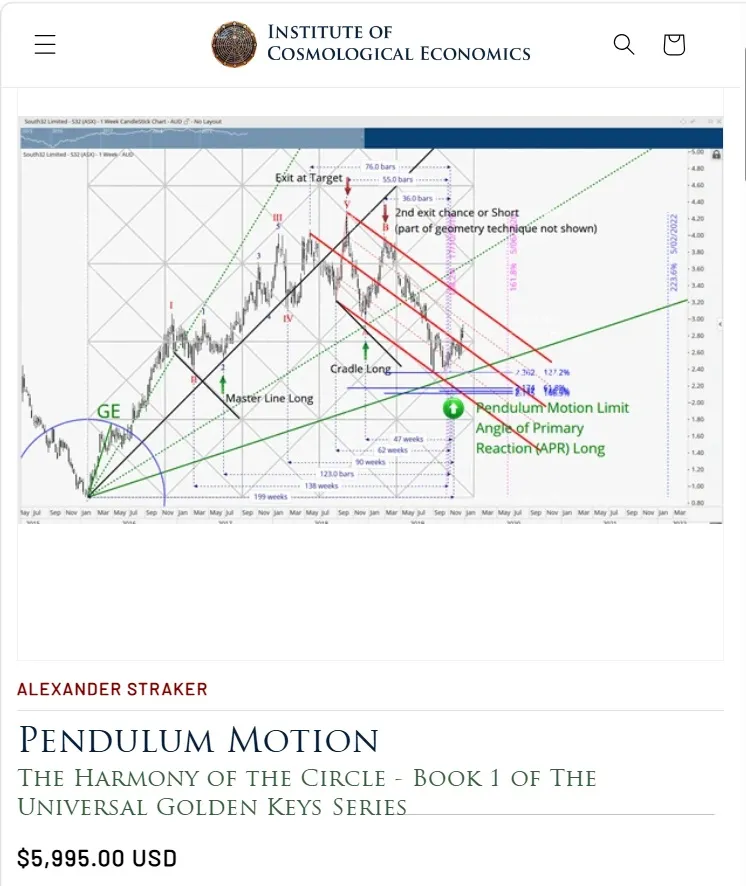
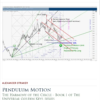
Pendulum Motion by Alexander Straker is a 358-page ebook exploring Circular Scaling, time-by-degrees, harmonic science, geometry, and market structure. The book presents Straker’s Pendulum Motion framework for analyzing price and time through rotational mechanics, vectors, angles, cycles, and Golden Mean relationships.
Original Sales Page: Pendulum Motion by Alexander Straker Sales Page
What Is Pendulum Motion by Alexander Straker?
Pendulum Motion: The Harmony of the Circle – Book 1 of The Universal Golden Keys Series presents Alexander Straker’s approach to market analysis through Circular Scaling and time-by-degrees.
The book focuses on the mathematical and geometric relationships that Straker believes underpin price and time movement. It combines harmonic science, ancient geometry, symmetry, cycles, vectors, and rotational mechanics into a framework for studying financial markets.
A central theme is the correct scaling of price and time. Straker argues that establishing the appropriate mathematical relationship between these dimensions is essential before applying geometric forecasting tools.
The Core Concept Behind Pendulum Motion
The central idea behind Pendulum Motion is Circular Scaling.
Instead of treating a financial chart as an ordinary rectangular grid, Straker presents a circular and rotational framework in which time can be expressed through degrees. This creates a foundation for examining the relationship between time, price, rotation, and geometry.
The framework can be understood through the following progression:
- Time
- Degrees
- Rotation
- Circular geometry
- Price/time relationships
- Pendulum Motion
According to the author’s approach, correctly establishing the scale is an important first step for applying geometric techniques to market analysis.
Harmonic Science and the Golden Mean
The book begins by establishing the mathematical and conceptual foundation behind its approach.
Section 1 explores harmonic science, resonance, the Golden Mean, Fibonacci relationships, fractals, and Elliott Wave structures.
Topics include:
- Characteristics of harmonics
- Points of resonance in the market
- Price behavior at points of resonance
- Music as a model for market behavior
- The octave principle
- Seed vectors and future growth
- Golden Mean mathematics
- Fibonacci and fractal structures
- Mathematical patterns found in nature
- Growth patterns and harmonic relationships
This section provides the foundation for the geometric and market applications developed later in the book.
Circular Scaling and Time-by-Degrees
One of the book’s defining concepts is Time-by-Degrees.
Straker presents a method for expressing the passage of time through rotational degrees, creating a circular framework for examining market movement.
The book explores:
- Time-by-degrees charting
- Circular scaling
- Rotational mechanics
- Price and time relationships
- Pendulum reaction angles
- Vector angles
- Harmonic scaling
- Circle-based mathematical relationships
This approach forms the basis for the Pendulum Motion system presented throughout Book 1.
Understanding Pendulum Motion
Straker describes market movement through an action-and-reaction framework.
The book examines how an initial price movement can be treated as a vector or impulse, followed by movement between opposing forces and reaction points. This provides the conceptual foundation for applying pendulum mechanics to market structure.
Key concepts include:
- Pendulum Motion
- Vector thrust
- Vector magnitude and direction
- Lines of force
- Angle of reaction
- Action and reaction
- Nodes of wave motion
- Time flow in contrary motion
- Rotational movement
- Price speed
The framework is presented as an application of physics, geometry, symmetry, and cycles to financial-market analysis.
Why Scaling Matters
A significant portion of Pendulum Motion addresses the challenges surrounding chart scaling.
Straker specifically examines the conventional Gann 1:1 scale principle and the difficulties traders may encounter when attempting to apply Gann angles to charts.
The book then introduces its alternative approach based on Circular Scaling, including:
- Harmonic scale adjustment
- Circle-based scaling
- Vector scaling
- Pendulum Motion scaling
- Time-by-degrees
- Mathematical relationships between price and time
- The relationship between scale and geometric projections
The objective is to establish a mathematically structured approach to scaling before applying geometric market tools.
Harmonic Scaling and Baumring’s Gnomonic Principles
The book connects Circular Scaling with Baumring’s Gnomonic principles and explores how geometric growth can be represented through circular structures.
This section covers:
- Harmonic scaling of vectors
- Pendulum Motion
- Square versus circle-based scaling
- Circle-based mathematical principles
- Universal principles of Pendulum Motion
- Gann’s key hint
- Pendulum forces
- Time-by-degrees progression
- Spiral growth
- Circular vector scaling
- Circle geometry
These ideas lead into the mathematical framework used for the book’s practical applications.
Circle-Based Harmonic Vector Scaling
Straker develops the circle-based approach further by examining how price can be geometrically related to time as rotation.
The methodology explores:
- Establishing a starting point
- Geometrically squaring price with time as rotation
- Setting the Pendulum Motion scale
- Pendulum reaction angles
- Critical support angles
- Harmonic scale adjustments
The result is a framework designed to connect price, time, angles, and rotational geometry.
Pendulum Tunnels and Median Lines
The book introduces Pendulum Tunnels, another application of the Pendulum Motion framework.
These concepts include:
- Pendulum Motion extension lines
- Scaled median lines
- Single-vector analysis
- Pendulum Motion median-line applications
The techniques build upon the earlier discussion of vectors, scaling, and market geometry.
Pentagonal Harmonic Growth
Later chapters introduce pentagonal structures and harmonic growth templates.
The book examines how market movement can be studied through:
- Seed Vector DNA
- Square grid templates
- Arc limits of growth
- Boxes and overall squares
- Elliott Wave impulse structures
- Fractal growth
- Vector thrust
- Market rotation
- Palindromic Pendulum Motion
These concepts extend the earlier discussion of harmonic growth and geometric market structure.
Timing Techniques
Timing is another important component of the methodology.
The book examines several approaches to connecting time with market movement, including:
- Simple price-time squares
- Time-cycle similarity
- Elliott Wave time retracement zones
- Time counts
- Time cycles
- Gann squares
These techniques are presented alongside the book’s broader Circular Scaling framework.
Targets, Setups and Campaigns
The final practical section of the book brings together the concepts developed throughout the earlier chapters.
The listed applications include:
- Core Pendulum Angle Set Up
- Pendulum Tunnel Campaign
- Pentagonal Growth Template Campaign
- Final Frontier Campaign
- Seed-of-growth analysis
- End-of-Wave-5 analysis
These applications demonstrate how the author connects scaling, geometry, timing, vectors, and harmonic structures within a broader market-analysis process.
Advanced Harmonics, Numbers and Cycles
The final section explores the mathematical and conceptual relationships between harmonic structures, numbers, music, geometry, and natural cycles.
Topics include:
- Mathematical harmonics from the Golden Mean
- Circle geometry
- Natural cycles
- Golden Section relationships
- DNA and spiral structures
- Pentagonal structures
- Human-body proportions
- The speed of light
- Music and key numbers
- Harmonic triads
- Golden Mean ratios
- Rotational energy
- Measurement of time
This section provides additional theoretical context for the harmonic principles used throughout the book.
The Straker Golden Mean Cycle
The book concludes its listed material with the Straker Golden Mean Cycle (SGMC).
The concepts include:
- Harmonic Triad Degree Values
- SGMC time counts
- Solar degree harmonics
- Spiral growth harmonic angles
- Golden Mean and circle ratios
- Hurst nominal cycles
- SGMC harmonic triad key degrees
- Planetary cycles and SGMC
- Rotational energy
- Natural cycles
- Measurement of time
The astronomical and planetary material here should not be confused with the later volumes of the series. This product is Book 1: Pendulum Motion, while the supplied series description identifies later volumes as separate works.
About Alexander Straker
Alexander Straker is described as a financial industry professional with extensive experience in technical analysis, cash-flow management algorithms, market research, and strategy development.
He also has a background in music and education. Recognized as a child prodigy in music during his youth, Straker went on to gain university qualifications and work professionally as a musician and educator.
His interest in Gann’s work began early in his life and eventually developed into more than three decades of research into harmonic science, geometry, mathematics, and market analysis.
A recurring theme in his research is the question of why particular technical-analysis tools work. His work seeks to examine the mathematical and geometric principles behind those tools rather than simply accepting that they produce results.
The Universal Golden Keys Series
Pendulum Motion is Book 1 of The Universal Golden Keys Series.
The supplied publisher material describes the series as containing separate books built around different theoretical frameworks.
Book 1: Pendulum Motion focuses on Circular Scaling via Time-by-Degrees.
The publisher describes Book 2: Golden Speed as focusing on square scaling associated with W. D. Gann. The books are presented as standalone works, meaning readers do not need to purchase Book 1 before exploring the other volumes.
This product listing is specifically for Book 1: Pendulum Motion.
What You Will Receive
This product contains the digital PDF edition of:
- Full Title: Pendulum Motion: The Harmony of the Circle – Book 1 of The Universal Golden Keys Series
- Author: Alexander Straker
- Format: Digital PDF
- Length: 358 pages
- Series: The Universal Golden Keys Series
- Volume: Book 1
- Core Framework: Circular Scaling and Time-by-Degrees
- Primary Subjects: Harmonics, Golden Mean, geometry, vectors, cycles, scaling, Pendulum Motion, price/time relationships, and market structure
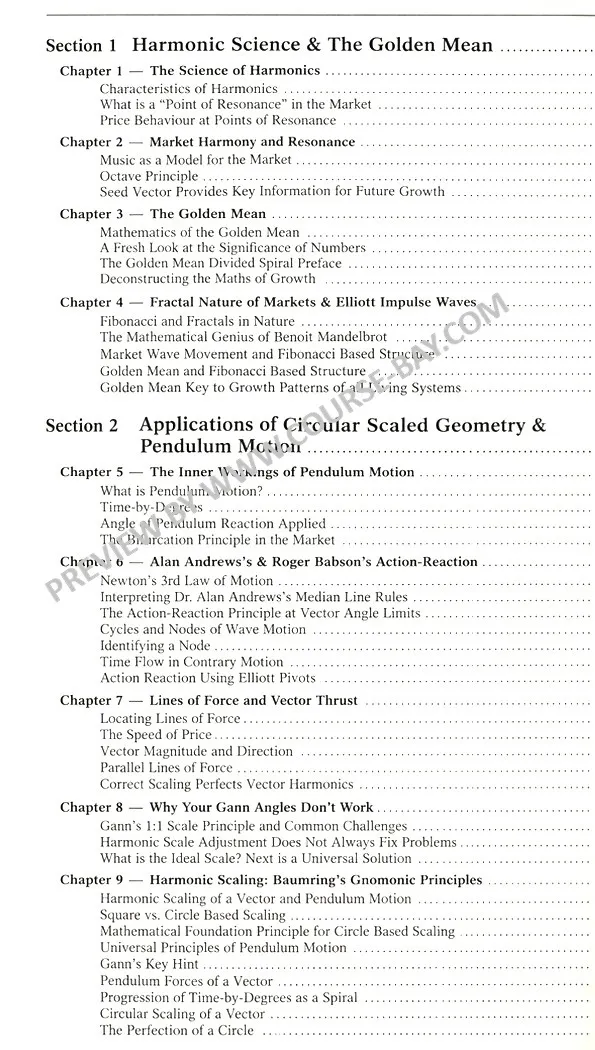
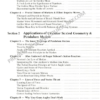
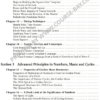
Complete Course Curriculum & Breakdown
Section 1
Harmonic Science & The Golden Mean
Chapter 1 — The Science of Harmonics
- Characteristics of Harmonics
- What is a “Point of Resonance” in the Market
- Price Behaviour at Points of Resonance
Chapter 2 — Market Harmony and Resonance
- Music as a Model for the Market
- Octave Principle
- Seed Vector Provides Key Information for Future Growth
Chapter 3 — The Golden Mean — Page 18
- Mathematics of the Golden Mean
- A Fresh Look at the Significance of Numbers
- The Golden Mean Divided Spiral Preface
- Deconstructing the Maths of Growth
Chapter 4 — Fractal Nature of Markets & Elliott Impulse Waves
- Fibonacci and Fractals in Nature
- The Mathematical Genius of Benoit Mandelbrot
- Market Wave Movement and Fibonacci Based Structure
- Golden Mean and Fibonacci Based Structure
- Golden Mean Key to Growth Patterns of all Living Systems
Section 2
Applications of Circular Scaled Geometry & Pendulum Motion
Chapter 5 — The Inner Workings of Pendulum Motion
- What is Pendulum Motion?
- Time-by-Degrees
- Angle of Pendulum Reaction Applied
- The Bifurcation Principle in the Market
Chapter 6 — Alan Andrews’s & Roger Babson’s Action-Reaction
- Newton’s 3rd Law of Motion
- Interpreting Dr. Alan Andrews’s Median Line Rules
- The Action-Reaction Principle at Vector Angle Limits
- Cycles and Nodes of Wave Motion
- Identifying a Node
- Time Flow in Contrary Motion
- Action Reaction Using Elliott Pivots
Chapter 7 — Lines of Force and Vector Thrust
- Locating Lines of Force
- The Speed of Price
- Vector Magnitude and Direction
- Parallel Lines of Force
- Correct Scaling Perfects Vector Harmonics
Chapter 8 — Why Your Gann Angles Don’t Work
- Gann’s 1:1 Scale Principle and Common Challenges
- Harmonic Scale Adjustment Does Not Always Fix Problems
- What is the Ideal Scale? Next is a Universal Solution
Chapter 9 — Harmonic Scaling: Baumring’s Gnomonic Principles
- Harmonic Scaling of a Vector and Pendulum Motion
- Square vs. Circle Based Scaling
- Mathematical Foundation Principle for Circle Based Scaling
- Universal Principles of Pendulum Motion
- Gann’s Key Hint
- Pendulum Forces of a Vector
- Progression of Time-by-Degrees as a Spiral
- Circular Scaling of a Vector
- The Perfection of a Circle
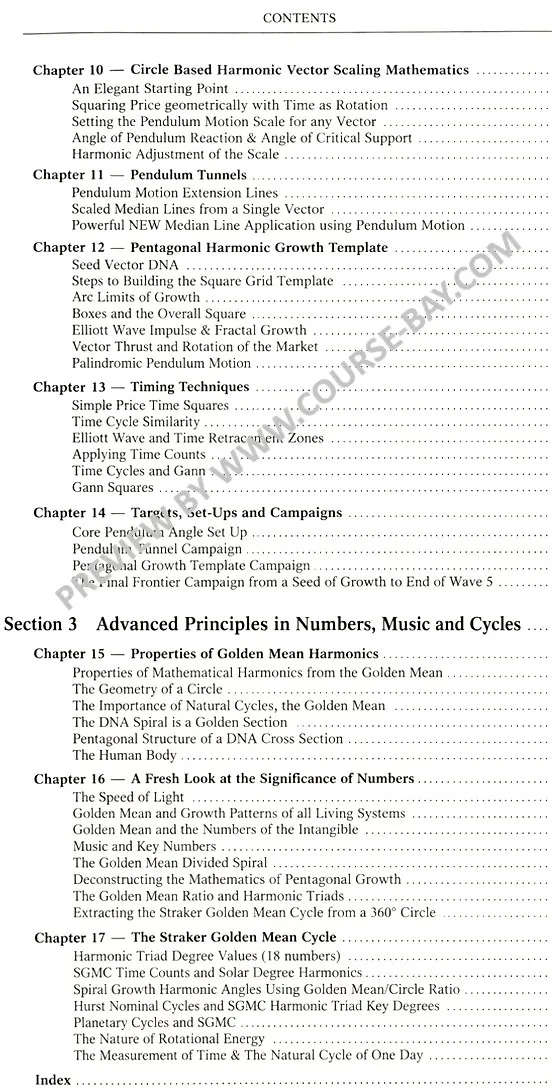
Chapter 10 — Circle Based Harmonic Vector Scaling Mathematics
- An Elegant Starting Point
- Squaring Price geometrically with Time as Rotation
- Setting the Pendulum Motion Scale for any Vector
- Angle of Pendulum Reaction & Angle of Critical Support
- Harmonic Adjustment of the Scale
Chapter 11 — Pendulum Tunnels
- Pendulum Motion Extension Lines
- Scaled Median Lines from a Single Vector
- Powerful NEW Median Line Application using Pendulum Motion
- Page number obscured in the image
Chapter 12 — Pentagonal Harmonic Growth Template
- Seed Vector DNA
- Steps to Building the Square Grid Template
- Arc Limits of Growth
- Boxes and the Overall Square
- Elliott Wave Impulse & Fractal Growth
- Vector Thrust and Rotation of the Market
- Palindromic Pendulum Motion
Chapter 13 — Timing Techniques
- Simple Price Time Squares
- Time Cycle Similarity
- Elliott Wave and Time Retracement Zones
- Applying Time Counts
- Time Cycles and Gann
- Gann Squares
Chapter 14 — Targets, Set-Ups and Campaigns
- Core Pendulum Angle Set Up
- Pendulum Tunnel Campaign
- Pentagonal Growth Template Campaign
- The Final Frontier Campaign from a Seed of Growth to End of Wave 5
Section 3
Advanced Principles in Numbers, Music and Cycles
Chapter 15 — Properties of Golden Mean Harmonics
- Properties of Mathematical Harmonics from the Golden Mean
- The Geometry of a Circle
- The Importance of Natural Cycles, the Golden Mean
- The DNA Spiral is a Golden Section
- Pentagonal Structure of a DNA Cross Section
- The Human Body
Chapter 16 — A Fresh Look at the Significance of Numbers
- The Speed of Light
- Golden Mean and Growth Patterns of all Living Systems
- Golden Mean and the Numbers of the Intangible
- Music and Key Numbers
- The Golden Mean Divided Spiral
- Deconstructing the Mathematics of Pentagonal Growth
- The Golden Mean Ratio and Harmonic Triads
- Extracting the Straker Golden Mean Cycle from a 360° Circle
Chapter 17 — The Straker Golden Mean Cycle
- Harmonic Triad Degree Values (18 numbers)
- SGMC Time Counts and Solar Degree Harmonics
- Spiral Growth Harmonic Angles Using Golden Mean/Circle Ratio
- Hurst Nominal Cycles and SGMC Harmonic Triad Key Degrees
- Planetary Cycles and SGMC
- The Nature of Rotational Energy
- The Measurement of Time & The Natural Cycle of One Day