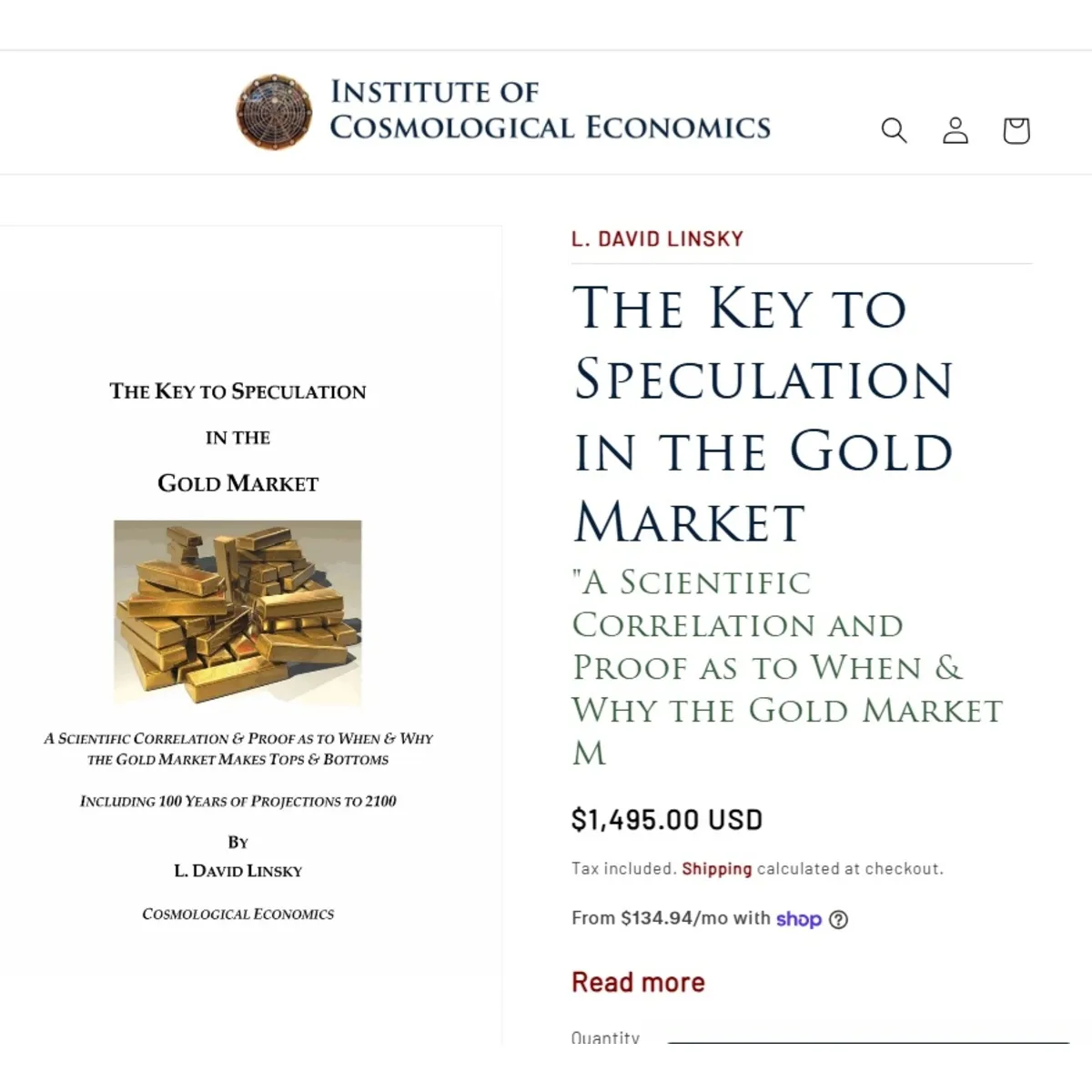
The Key to Speculation in the Gold Market by L. David Linsky is a 206-page ebook exploring a scientific, cycle-based approach to identifying major Gold market tops and bottoms. It examines historical Gold prices, recurring patterns, and geopolitical events to help traders understand the timing behind Gold’s major market swings.
Original Sales Page: The Key to Speculation in the Gold Market Sales Page
What Is The Key to Speculation in the Gold Market?
The Key to Speculation in the Gold Market presents L. David Linsky’s research into the recurring cycles and mathematical patterns he believes influence major movements in the Gold market.
The book focuses on identifying the timing behind significant Gold market tops and bottoms. Rather than concentrating solely on conventional price analysis, Linsky examines historical cycles and correlations to develop a framework for studying Gold’s larger market swings.
The complete ebook contains 206 pages of research, historical data, market analysis, and supporting concepts.
Gold Market Cycles and Major Turning Points
At the heart of the book is Linsky’s proposed cycle model for studying major Gold market movements.
The research examines:
- Recurring cycles associated with major Gold market turning points
- Historical Gold prices and significant price changes
- Patterns that may help identify major market tops and bottoms
- The relationship between timing cycles and Gold price movements
- Historical market behavior extending across centuries of Gold-price data
- Correlations between Gold cycles and significant geopolitical events
- The freely traded Gold market beginning in the 1970s
- Historical evidence used to support the author’s cycle-based model
A Historical Study of the Gold Market
The book places modern Gold speculation within a much broader historical context.
Linsky examines Gold pricing across hundreds of years, including periods when governments controlled or fixed Gold prices. He also discusses how wars, inflationary pressures, currency confidence, exchange rates, and geopolitical developments influenced Gold pricing.
This historical perspective provides context for understanding how Gold has behaved under different economic and political conditions.
Geopolitical Events and Gold Prices
Gold has historically been closely connected to major economic and geopolitical developments. The book therefore examines significant historical events alongside Gold price movements.
Topics discussed include:
- Historical Gold-price fixing
- Government-controlled Gold prices
- The development of freely traded Gold markets
- Wars and military conflicts
- Inflationary pressures
- Confidence in paper currencies
- International exchange rates
- Geopolitical events and their relationship to Gold prices
By comparing historical events with Gold-price behavior, the book attempts to identify recurring relationships within the market.
The Scientific Correlation Behind the Model
Linsky’s central thesis is that Gold contains an underlying pattern that can be studied through specific cycles.
The book presents his research into:
- Mathematical relationships within Gold market cycles
- The timing of major market swings
- Historical correlations between cycles and Gold prices
- The proposed ordering principle behind significant Gold movements
- Evidence drawn from historical Gold-market data
- A cycle-based framework for studying future market timing
The approach is presented as an attempt to identify the underlying order behind Gold’s larger movements rather than simply following short-term price fluctuations.
Gold Market Applications
The concepts discussed in the book can be considered in connection with several forms of Gold-related investment and speculation.
The supplied material identifies applications including:
- Physical Gold
- Gold-related stocks
- Gold options
- Gold ETFs
- Gold futures
- Bullion
- Gold coins
- Gold jewelry
The underlying idea is that understanding potential turning points in the Gold market may provide a broader perspective when evaluating instruments that are highly correlated with Gold.
Research Influences and Market Cycle Studies
In the author’s foreword, Linsky acknowledges a range of researchers and market analysts whose work contributed to the broader foundation of his research.
These include W. D. Gann, Sepharial, George Bayer, L. J. Jensen, Professor Weston, J. H. Nelson, J. M. Langham, Donald Bradley, Samuel Benner, T. G. Butaney, Lcdr. David Williams, M. W. Walker, Bradley Cowan, Bryce Gilmore, Daniel Ferrara, Granville Cooley, Patrick Mikula, Jack Gillen, J. M. Hurst, Jeanne Long, Michal Jenkins, Dr. Ruth Miller, Larry Pesavento, and Kaye Shinker.
Linsky explains that his primary cycle discoveries are his own work while acknowledging the foundational research that influenced his study of financial forecasting and market cycles.
About L. David Linsky
L. David Linsky spent many years researching the underlying causes of market fluctuations. Although he was not directly employed in the financial industry, he studied Gold-market newsletters and research while searching for a recurring cycle, order, or pattern that could help identify when major Gold movements might occur.
His research ultimately led him to what he describes as an ordering principle behind Gold’s major market swings.
What You Will Get
This digital product contains the complete 206-page PDF ebook:
- The Key to Speculation in the Gold Market
- Author: L. David Linsky
- Full subtitle: A Scientific Correlation and Proof as to When & Why the Gold Market Makes Tops and Bottoms
- Format: PDF ebook
- Length: 206 pages
- Focus: Gold market cycles, historical correlations, market tops and bottoms, and speculative timing
- Historical scope: Gold-price data spanning modern free-market trading and earlier historical periods
Important Note
The author states that the research is not intended to constitute financial advice. The material is presented as a study of Gold-market cycles, historical correlations, and potential market timing.
Past market behavior does not guarantee future results. Buyers should conduct their own research and consider their individual circumstances before making financial decisions.